It seems that Recreational Vehicles are becoming more and more popular and so there is increasingly the presence of an RV receptacle or multi receptacle RV box located somewhere on the property. Sometimes it’s in the middle of a field. Because the RV receptacle is different than other receptacles that we find in the typical home I wanted to spend some time explaining them. You see, the RV receptacle is wired specifically for an RV. While a home has both 120 volt and 240 volt circuits the RV is only 120 volts. This can be confusing to some “amateur electricians” because a regular 240 volt dryer cord looks real similar to a RV cord. Both have three prongs but the three prong dryer cord has an L shaped ground prong. The ground prong for a RV is round. Also a 30 amp dryer is wired for 240 volts whereas a RV outlet is only wired for 120 volts. In fact, generally almost all RV’s only use 120 volt circuits exclusively. So this requires special wiring procedures.
There are basically two types of RV receptacle boxes. The 30 amp receptacle box and the 50,30,20 amp receptacle power panel. Before we go any farther I just want to say that this article is just meant to be informative but not instructional. Get an actual electrician to wire any project you have going on. First we’ll talk about the 30 amp RV receptacle box.
The 30 amp 120 volt RV receptacle
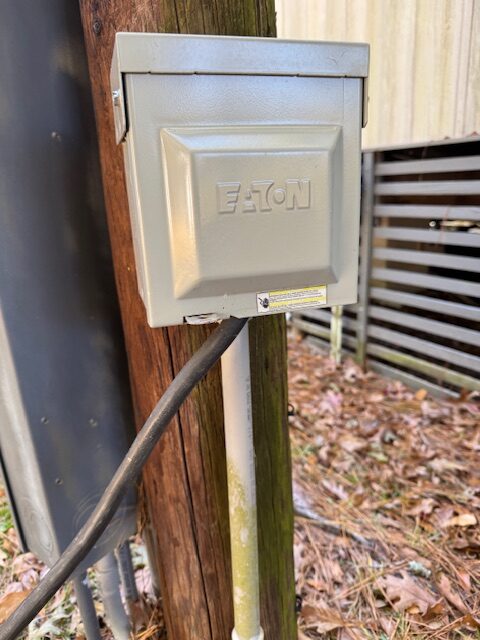
Picture above show a typical use for a 30 amp RV receptacle box.
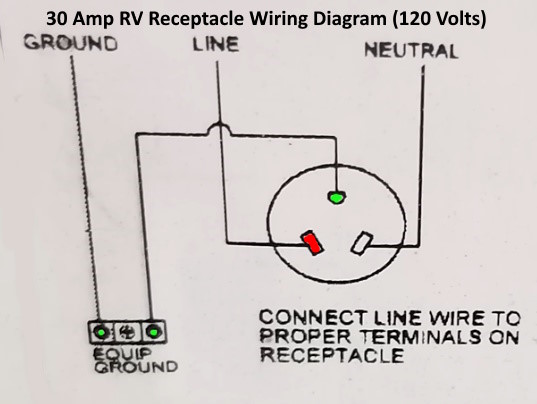
Typical wiring for a 30 amp RV receptacle outlet. Notice that only one conductor is hot.
A 30 amp RV cord only has three conductors like almost all modern 120 volt appliances. A hot, a neutral and a grounding conductor. The receptacle itself is wired with a #10 AWG or better feeder cable. If it’s outside it must be rated for wet locations (UF type). The cable will be protected by a 30 amp single pole breaker at the panel.
It’s important not to assume that your electrician understand this as miss-wiring a 30 amp RV outlet is a common occurrence. Should it happen it would damage appliances in the RV. Make sure he knows that RV’s only use 120 volt circuits.
The 50, 30,20 amp RV receptacle power panel
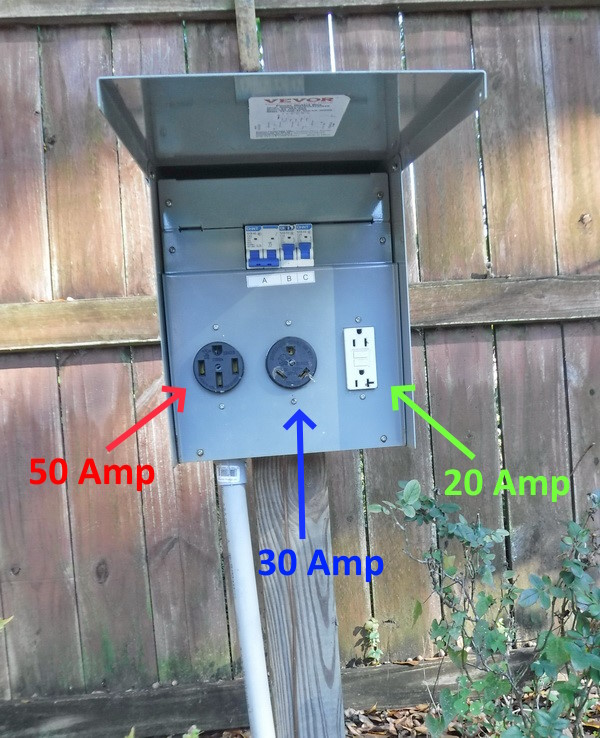
The other type of power panel we see for RV’s have three receptacle outlets for the three types of RV power cords. It’ll have a 20amp receptacle for small RV’s like popups. It’ll have a 30 amp RV receptacle for average size campers and a 50 amp receptacle for really large campers. This type of panel is fed with a 4 wire feeder using #6 AWG conductors (typically two hots, an insulated neutral and a bare grounding conductor). If they’re outside then they have to be rated for wet locations.
RV 3 receptacle power panel with outlets identified.
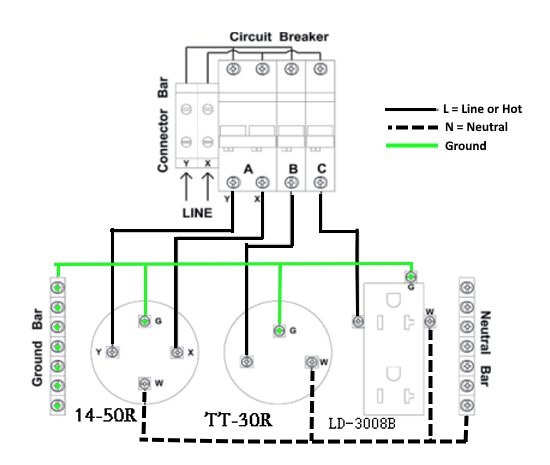
Typical RV 3 receptacle power panel wiring diagram.
This panel is wired like a subpanel with a 4 wire feed (the grounding and neutral conductors must be separated). The hot legs of the 50 amp receptacle actually serves two 120 volt circuits in the RV. It works much like the multi-wire circuit I discussed in another article. Now this panel can be fed with conductors protected by a 50 amp 240 volt double pole breaker located at the main or sub panel; the two hot legs of the 50 amp RV circuit serve two separate 120 volt circuits in the RV.
About the RV Power Panel Breakers
The breaker labeling on these receptacles can be confusing because the rating is not stamped on the handle like normal household breakers. However they are sized correctly for the outlets on the panel thus 50 amp, 30 amp, 20 amp is adequately protected as it is a pre-made manufactured unit. Now lets look at the power capabilities of each circuit.
20 amps x 120 volts = 2400 watts
30 amps x 120 volts = 3600 watts
2 legs x 50 amps x 120 volts = 12000 watts
While the power requirements of each size RV is different it’s logical to assume that the more electrical demands the larger the breaker needs to be.